Historic Sites
St. Walburg Churches & Cemeteries
Trinity Lutheran Church 113 3 St W
Focusing on Biblical and Confessional Lutheran teachings since 1914. Building the first Lutheran church began in 1927 and was completed and dedicated in 1930. When the original church was no longer viable to use, services were held in homes and the local United Church until a new Church could be built. In 1986 the congregation was able to built a modern, wheelchair-accessible facility to replace their original building, and meet the needs of their members. Services are held on Sundays at 10:30
Saints Peter and Paul Russo Greek Orthodox Church and Cemetery 2nd Ave. & 2nd St. East
Founded in 1925 by Slavic pioneers and a resting place for the community’s Greek Orthodox pioneer immigrants from Poland, Russian, and Ukrainian descent. The Greek Orthodox Church was completed and consecrated 1930. Today there are no services anymore and many of the members are in their final resting place. A few remaining family members continue to look after the building and grounds in respect for a lives that were. Others have moved on to establish their own paths.
Assumption Roman Catholic Church and Cemetery 6 - 2nd Ave. SE 5-54-22 W3rd.
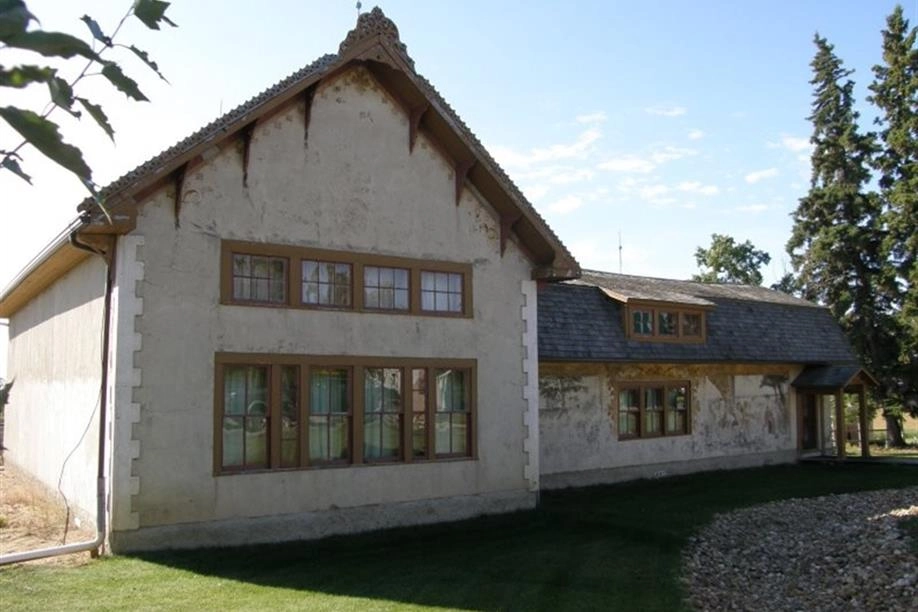
The shell for the new Church was up by Christmas of 1924 and the first mass celebrated as well at this time. Today this church serves as our museum, opening its doors in 1984 and features the beautiful oil paintings done in 1935 by Count Berthold Imhoff, a pioneer of the Marguerite district. A second church was built and in May of 1984 the first mass was held. Behind the church today stands a grotto, with a shrine dedicated to “Our Lady of Lourdes”. All stones were hand-picked, “fieldstones,” gathered from local farms and carefully placed to build this beautiful monument. Mass is held Sundays at 11:00 am and weekdays at 9:00 am.
Seventh – Day Adventist Church South of the school in St. Walburg, on highway 26.
This congregation has long provided a distinct spiritual perspective in the community, often emphasizing health, education, and community service. In the mid 70’s they purchased 4 acres of land to build a church and establish their own place of worship. With most of the labour and equipment being donated the church was successfully built and officially organized on May 15,1976. Services are held weekly on Saturdays, the Sabbath 10:00 am Bible study and 11:00 Worship service.
St. Walburg Municipal Cemetery Two minutes south of town, NE 29-53-22 W3rd In 1944, the town of St. Walburg officially received Town Status. The community’s primary cemetery has burials dating back to 1940.
St. Marguerite Cemetery A 7 minute drive south on highway 26 for 3.6 km, turn right onto highway 3 for another 3.6 km and you will see it on the left. NW18-53-22 W3rd Settlers of French, German, Belgian and English ancestry came to this area between 1908-1911. A pioneer by the named J. Bertrand donated land for the construction of a church, rectory and cemetery. The site soon became a center for church activities serving a large surrounding area. In 1918 a severe windstorm blew the roof off the church and toppled the bell tower. Plans were made to rebuild, but with the arrival of the railway and the growth of the new town of St. Walburg, the Bishop of the diocese, declined permission to rebuild on the original site. Instead, a new church was constructed in St. Walburg. The final mass at the original location was held in November of 1924.
In 1981 parishioners from St. Walburg restored the original St. Marguerite Cemetery. Two years later in 1983, a monument was erected and topped with the church’s original bell, preserving an important piece of the area’s history.
Spruce Bluff Cemetery 14 minutes south of town, NW 30-52-21-W3rd in the RM of Mervin No. 499 The cemetery serves as a record of families who built the elevators, shops and schools, being a critical stop on the rail line that fueled the growth of St. Walburg, highlighting the interconnectedness of the small hamlets that once thrived every few miles along the tracks. The first known burial was in 1919.
Liberty Cemetery 10 minute drive north of town, SW 27-54-22-W3rd, within the RM of Frenchman Butte 501 Serving early homesteaders north of town with the first known recorded burial in 1917.
Glenbogie Cemetery 15 minutes drive west of town, SE-21 54-23 W3rd, in the RM of Frenchman Butte 501 Glenbogie Cemetery is closely connected to the historic Glenbogie district, one of the area’s early settlement communities. The district became home to many European immigrants who helped shape the region’s agriculture and cultural heritage. The earliest known marked grave in the cemetery dates to 1916, providing a lasting connection to the pioneers who established their homes in this part of Saskatchewan.
W St. Johns Cemetery 14 minutes drive west of town, S02-54-24W3rd, in the RM of Frenchman Butte 501 Established in 1918, St. Johns Cemetery was created to serve the spiritual and burial needs of the early homesteaders and pioneers who settled the parkland region of the North Saskatchewan River during a period of rapid agricultural development. Today, the cemetery stands as a reminder of the families and individuals whose hard work and determination helped establish the thriving rural communities of the area.
Emmaville Cemetery 18 minute drive, south of town, NW24-52-22 W3rd, 52363 Range Road 3221
The Emmaville area was first settled in 1907 by homesteaders from the United States, England, Norway, Sweden, Manitoba, and Ontario. The school district was establishedin 1908, and the Emmaville school opened in March of 1909. The school house quickly became the center of community life, hosting church services, Sunday school and local gatherings.
In 1929 the Emmaville Church became part of the St. Walburg Pastoral Charge of the United Church. The Church closed in 1958 and church and Sunday school services were relocated to Spruce Lake.
For many years the Emmaville district had no formal burial grounds, and early settlers were buried on their homesteads. When a municipal cemetery was established, the remains of several pioneer settlers were reinterred in the new burial ground. Emmaville Cemetery remans an active cemetery and continues to serve the community today.
Forest Home Cemetery SW 15-54-21 W3rd GPS Coordinates: 53.65756, - 109.01526
Nestled in the quiet, rolling prairie landscape east of St. Walburg, Forest Home Cemetery stands as a serene tribute to the early homesteaders who carved out a living in rural Saskatchewan. Located on the boundary of the historic Stowlea and Deer Valley districts, this peaceful country graveyard offers a fascinating glimpse into the region’s deep pioneer roots. Whether you are tracing your family genealogy, exploring the backroads of the Rural Municipality of Mervin No. 499, or seeking a quiet moment of reflection, Forest Home Cemetery is a beautiful stop on your journey through the Saskatchewan prairie. During the post-WWI immigration boom, families arrived in the heavily treed "bush country" east of St. Walburg to establish farms. As one-room schoolhouses like Deer Valley and Stowlea opened their doors, the community recognized the need for a dedicated, high-ground final resting place. The land for Forest Home was officially designated in the early 1920s, with its first burial occurring in 1922/1923. Walking through the gates today, visitors will see headstones bearing the names of the original American, Irish, English, German, and Scandinavian homesteading families
.
St. Anthony Sudeten Roman Catholic Cemetery (Also known as St. Walburg Sudeten Cemetery) A 15-20 minute drive east of St. Walburg towards Bright Sand within the RM of Mervin 499
St. Anthony Sudeten Roman Catholic Cemetery serves as a final resting place for several Sudeten German families who fled Czechoslovakia in 1939 just shortly before the outbreak of the Second World War. Seeking a new beginning, these settlers established homes and communities in the bushlands of Saskatchewan, overcoming numerous challenges to build a prosperous future. Today, the cemetery stands as a lasting tribute to their courage, perseverance, and determination. It honours a group of people who were forced to leave their homeland and successfully created a new life for themselves and future generations in west-central Saskatchewan.